Sarajevo guidebooks are full of information on cultural sights, history, where to sleep, eat, walk and have coffee.
You will probably also hear that Sarajevo is the Jerusalem of Europe, where East meets West, a city where people of different faiths have lived side by side for centuries.
But only locals will tell you the slightly magical story of the “Sarajevo Triangle of Wishes”. In the old part of town there are three places that everyone visits, whatever their religion, in the hope that their wishes will come true.
The Tomb of the Seven Brothers, the Catholic Church of St Anthony of Padua and the Old Orthodox Church of the Holy Archangels Michael and Gabriel form this magic circle.
According to the legend, the walk starts at the Tomb of the Seven Brothers, where custom says you drop a coin through the window and make a heartfelt wish for your loved ones. Then you continue to the church in Bistrik, where you can also leave a donation or light a candle and, of course, say whatever prayer you know, because, as they say, what matters is that it is sincere and from the heart.
The circle closes at the Old Orthodox Church in Baščaršija, where you again light a candle, may leave a small donation and say a prayer for help. Most people ask at these three places for health and happiness for those closest to them.
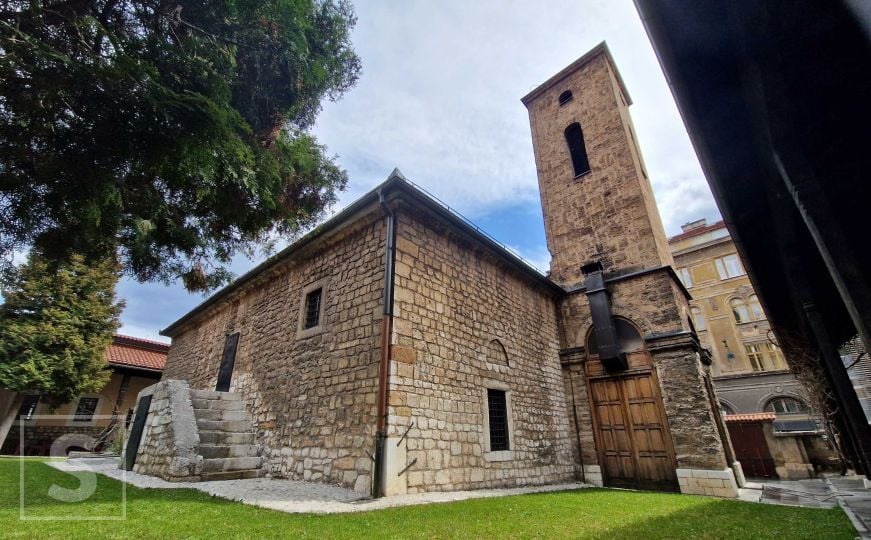
The Old Orthodox Church is one of Sarajevo’s oldest and most valuable monuments and among the oldest religious buildings in the region. It stands close to Baščaršija, on Mula Mustafe Bašeskije street.
The legend of how it was built

It was built during Sarajevo’s great expansion under Ottoman rule and the governor Gazi Husrev-beg, known as a great builder. It is first mentioned in 1539, but it is thought to stand on the foundations of an even older church.
The legend says that Gazi Husrev-beg agreed to the request of Sarajevo’s Orthodox community to build a church, on condition that it was simple and covered no more ground than the size of an ox hide.
A wise old man then had the idea of cutting the hide into thin strips and marking out as much land as was needed, meeting the bey’s condition to the letter. The great Gazi was delighted by this ingenuity and allowed the church to be built in the proportions known today.
The truth of the legend has never been confirmed, but it is one of the most charming stories about the ties between the people of Sarajevo.

The church has an unusual shape: it is wider than it is long. Although it was built as an Orthodox church meant to serve for centuries, its original design lacked one of the basic features of a church, a bell tower, which was added only in the early 20th century.
The first bell tower was wooden and only later was it built in stone. The reason was an Ottoman law that forbade buildings taller than a mosque.
At first the church had a single, very tall storey, but in the 17th century, when it became too small for the congregation, the height was divided by a wooden floor, creating a gallery for women.
The church was damaged by fire in 1788 and then received a new roof. The courtyard had an old well into which people threw coins, and its water, despite a metallic taste, was believed to heal.
A national monument of Bosnia and Herzegovina
In September 2006 the Commission to Preserve National Monuments of Bosnia and Herzegovina declared the Old Orthodox Church (Church of the Holy Archangels Michael and Gabriel) in Sarajevo a national monument.
The monument consists of the church, the churchyard, the museum building, the boundary wall, the entrance gate, the parish house and the movable heritage. Among other things, the museum holds a collection of 140 icons, four iconostasis fragments, 114 metal objects, 13 books, six old documents and 37 liturgical textiles and embroideries.
The museum of the Old Serbian Orthodox Church grew out of its treasury. The church warden Jeftan Despić deserves special credit for it: he came up with the idea of turning the treasury into a museum in 1889, after the National Museum opened in Sarajevo, and the upper floor of a storehouse in the churchyard was converted for the purpose.
During the Second World War the Old Church and its museum were neither damaged nor looted, thanks to Dr Jozo Petrović, then director of the National Museum.
Most of the museum’s objects are paintings by local and foreign artists.
It also keeps a number of handwritten and printed church books of great historical and artistic value, above all the Sarajevo Krmčija on parchment from the first half of the 14th century. Among the printed books are two Cetinje Octoechos of Đurađ Crnojević from 1493/94.
There are also many embroideries, vestments of gold brocade, church drapery and embroidered and woven belts with buckles. Metal objects include mounted crosses from the 17th and 18th centuries, censers, panagia holders and local and Venetian lamps. Objects in wood and carved stone are few.
The first written records of the treasury were published by Hilferding, and the first monograph on it was written in 1936 by Dr Lazar Mirković, professor at the Faculty of Theology in Belgrade.
Source: radiosarajevo.ba